We Actively Protect the Climate
Public transport protects the environment and makes better use of existing resources than private transport. Get on board and let's travel together into a low-emission future.

Active Climate Protectors Use Public Transport
The Rhine-Neckar metropolitan region, with its three vibrant major cities and its attractive, scenic hinterland, is considered one of the most liveable regions in Germany. The diverse range of public transport services also contributes to this, as trams, light rail, buses and a colourful mix of multimodal options enable people to reach their destinations quickly and safely. At the same time, we are making a significant contribution to climate protection because public transport is environmentally friendly and sustainable. Public transport makes much better use of available space in the city and at the same time transports significantly more people with much lower resource consumption than the car. So if you use public transport, you are making an active contribution to climate protection and to the high quality of life in our beautiful region.
The importance of climate protection is emphasised by the Warming Stripes. You can find more information here.
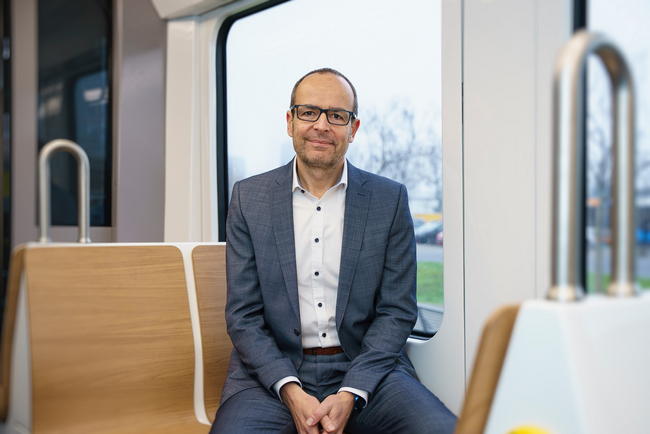
We have our sights firmly set on the goal of climate neutrality and our social responsibility. In order to leave future generations a planet worth living on, we must act now.
Christian Volz
Kaufmännischer Geschäftsführer der rnv GmbH
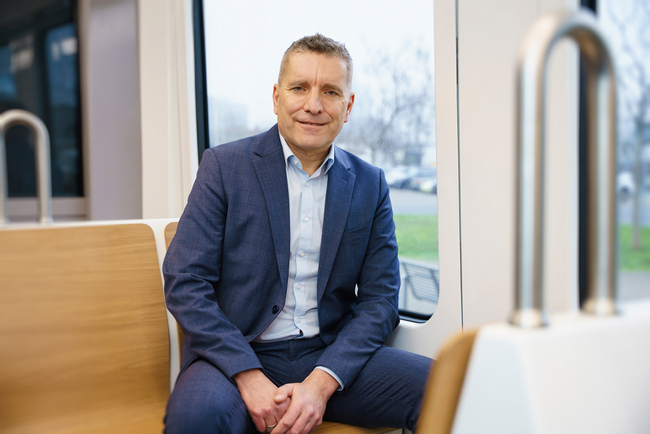
Public transport is the most environmentally friendly mode of transport per se. We become active climate protectors when we use public transport.
Martin in der Beek
Technischer Geschäftsführer der rnv GmbH
Every kilometre that we travel by bus or train instead of by car saves CO2 emissions. We are also working every day to make our company itself more sustainable.
Luise Berkmann
Nachhaltigkeitsmanagerin bei der rnv GmbH
Transport is a major contributor to global warming. Around 20 per cent of climate-damaging emissions in Germany are released in this sector, according to the Federal Environment Agency's National Greenhouse Gas Inventory 2021. Transport companies therefore have a special responsibility to reduce emissions in the transport sector.
Our Projects for More Climate Protection
100 Per Cent Green Electricity
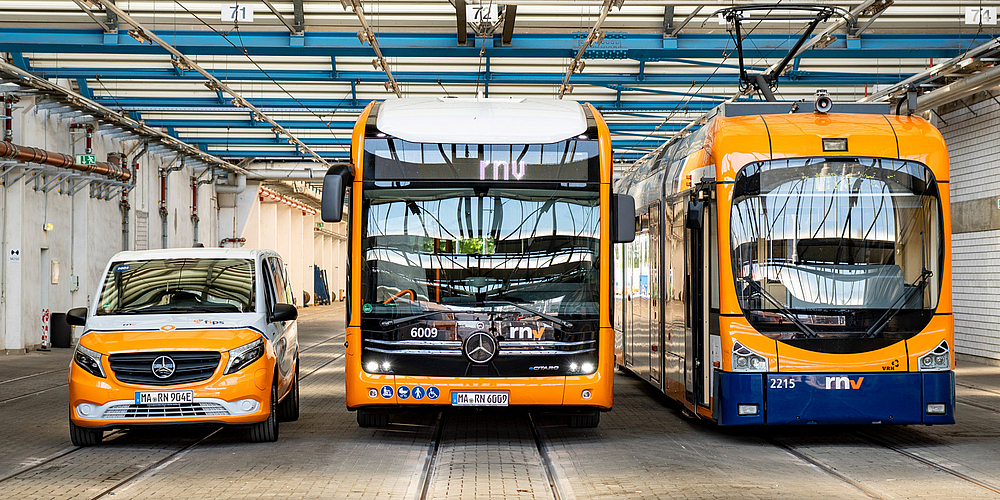
Wind, water, sun and co. are our fuel of the future. Since March 2014, our trams in Mannheim, Ludwigshafen and Heidelberg are running on 100 per cent green electricity with the lowest possible CO2 emissions. Our depots are also powered by electricity from renewable sources. And our goal has not yet been achieved.
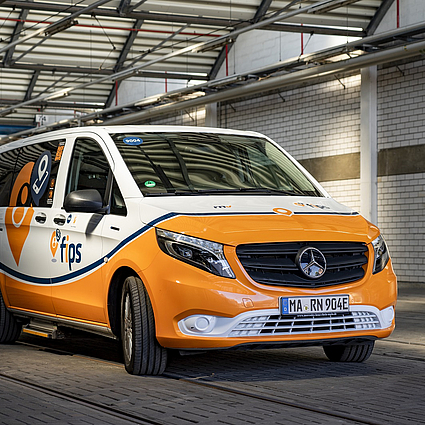
The entire fleet of our flexible individual passenger shuttles "fips" takes people in Mannheim and Heidelberg to their destinations fully electrically. Our e-buses have also been running on environmentally friendly green electricity right from the start. By 2032, our entire vehicle fleet should be running on green electricity.
Alternative Drives
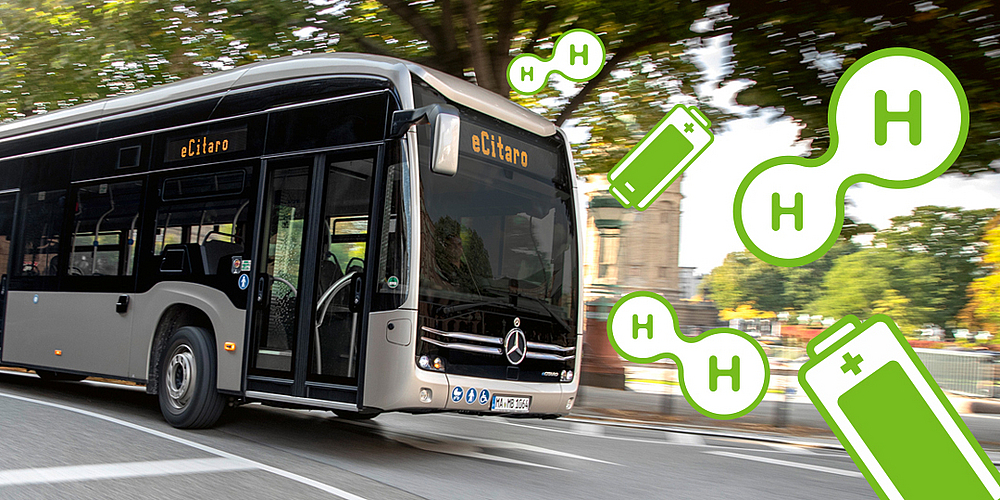
On some of our routes, an e-bus needs more than batteries to be able to provide the range we need in regular service. The large articulated buses or buses with long daily running times in particular would have to travel to the depots too often to recharge. During recharging times, additional buses would have to transport our passengers, which is why significantly more buses would have to be procured than with a fleet of diesel vehicles. For such a large fleet, we would also need more space to park them and larger depots, and, and, and. That's why we are constantly looking for new ways to cover the long distances and at the same time organise our operating processes in an efficient and resource-saving way.
The PRIMOVE project in 2012 was one of many attempts to solve the problem of range. The idea: panels are laid at bus stops to charge the batteries of an e-bus via induction while it is stopped. This was implemented in Mannheim on route 63, but the solution did not prove successful, which is why the project was cancelled.
Hydrogen is currently seen as the fuel of the future. It is converted into electricity with the oxygen in the air using fuel cells. As only water and heat are produced, but no carbon dioxide, hydrogen is considered an environmentally friendly fuel - especially if it has previously been produced using renewable energies.
For e-buses, this has the advantage that fuel cells can recharge the batteries while they are travelling, thereby greatly extending their range. Refuelling with hydrogen is also much faster than charging with electricity. That is why we have been building a new hydrogen bus depot in Heidelberg-Wieblingen since October 2022 and are expanding the Mannheim and Ludwigshafen depots with the corresponding infrastructure, which also includes public hydrogen refuelling stations. We have also ordered 40 new e-buses with fuel cell range extender technology and have the option of up to 75 to replace the remaining diesel buses with environmentally friendly and more climate-friendly successors in the coming years.
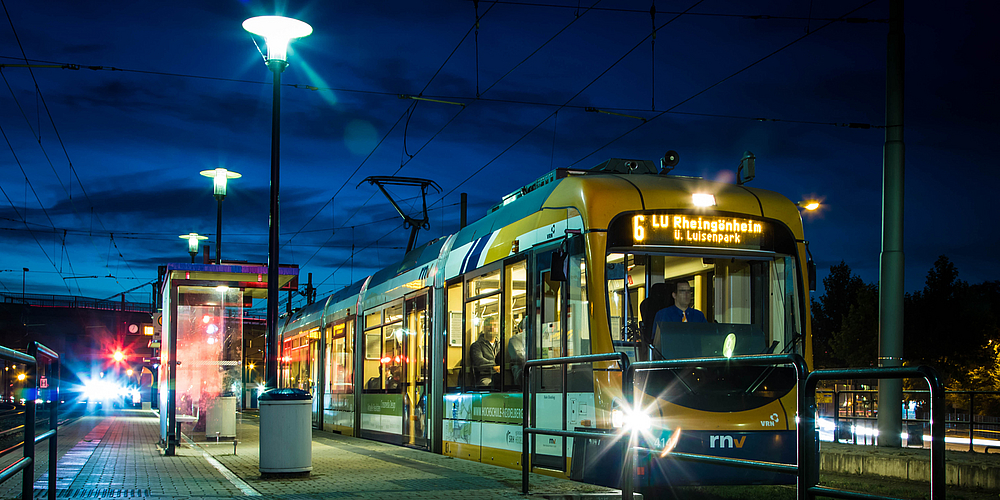
LED Lighting at Bus- and Tram Stops
Less power consumption, longer service life and brighter at the same time: these are the advantages of LED lamps. That's why we launched a project in 2020 in which we are gradually converting the lighting at our stops to LED technology. This enabled us to save 36,000 kilowatt hours of electricity and around 22 tonnes of carbon dioxide in the first year alone. At the same time, the brighter light of the LEDs ensures better illumination of our stops and therefore greater safety for our passengers.
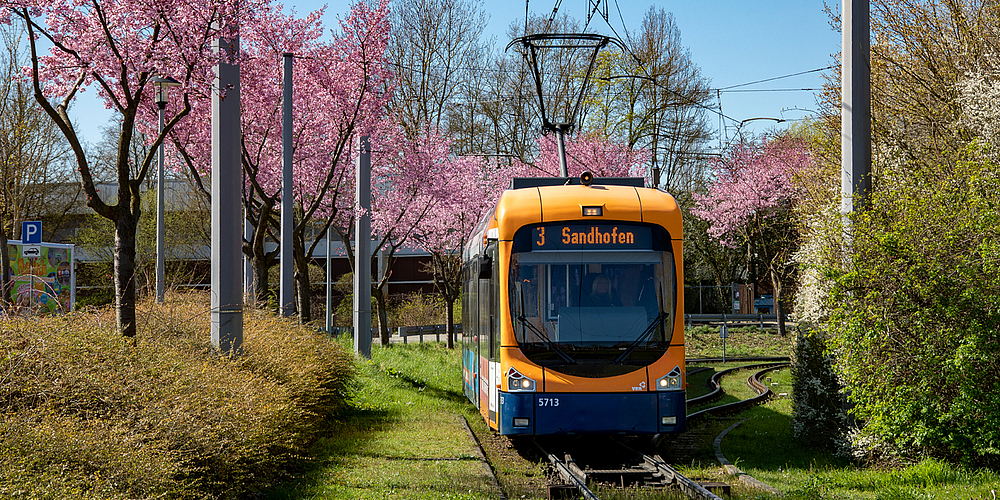
Green Tracks
A tram through the park? That's what you might think on some sections of our track network. But the green track beds offer much more than meets the eye.
Green tracks provide a pleasant climate. Because when it rains, they store more water than track beds made of ballast or asphalt. In hot, dry phases, this water evaporates and cools the surrounding air and the tracks. This allows our trains to reach their destinations more smoothly, even in summer. Because especially in hot summers, our trams would otherwise have to travel more slowly in some places where the tracks have become deformed due to the summer heat.
In addition, green tracks are nice to look at in the concrete and asphalt-heavy grey of city traffic. The plants growing there filter fine dust out of the air, convert carbon dioxide into oxygen and act as sound absorbers for tram traffic. We have already created around 160,000 square metres of green space in recent years and the number is growing every year.