

Dialogue Procedure
The Rhein-Neckar-Tram was to be as barrier-free as possible and easy for passengers to use. Achieving this was particularly important for the cities and local authorities as shareholders and public transport authorities. For this reason, rnv not only took applicable standards into account when designing the RNT and invited tenders in accordance with them. The actual needs of our passengers in terms of comfort, safety and user-friendliness were also to be determined and integrated into the RNT. An extensive dialogue process was therefore carried out.
Representatives of various interest groups were involved, such as people with disabilities, senior citizens, families and cyclists, customer and passenger associations as well as administrative staff. Over 200 responses on a wide range of topics were systematically recorded, analysed and checked for feasibility together with the manufacturer.
Overall, the vehicle concept was rated as "good/very good". Suggestions were made, such as the addition of touch fields for visually impaired people in the exterior area, a wider folding ramp, better stopping options or an acoustic signal for finding the doors, which could be implemented. In addition, the two main topics of "interior layout" and "seating arrangement" were identified. These include aspects of the
- design of the raised floor areas above the bogies,
- the accessibility of the entire vehicle,
- accessibility of the multifunctional area/wheelchair space,
- access to seats with fewer or no steps as well as
- possible conflicts of interest in the low-floor section
The Most Important Results at a Glance
| Topic/ impulse from dialogue process | Optimised implementation/ solution |
| Floor areas above the bogies, Passage situation in the entire vehicle, Possible conflicts of interest in the low-floor area | In the centre coach, the planned two steps to the raised floor section were replaced by ramps at the doors and in the articulation area. Within the available space, a continuous step-free, largely level centre aisle has been created. The psychological barrier effect is also significantly reduced and the passenger flow improved, which relieves the low-floor areas of potential conflicts of interest. |
| Accessibility of multifunctional area/wheelchair space | Thanks to a new, longitudinally offset arrangement of thedoors installed on both sides of the vehicle, the interior of the end carriages could be redesigned and the areas redistributed. In the previous design, the multifunctional area/wheelchair space was only accessible by manoeuvring forwards and backwards. In future, there will be two multifunctional areas per end carriage (with standardised orientation against the direction of travel in the front part of the vehicle), one of which can be reacheddirectly without changing direction, as in the old vehicles. |
| Access to seats with fewer/no steps | In front of the articulated areas in the end carriages, there are four fully-fledged seats at low-floor level. These are accessible at ground level without any steps. Thanks to the ramps to the raised vehicle areas in the centre carriage, only one step needs to be negotiated to reach the seating groups, instead of two previously. |
Mockup
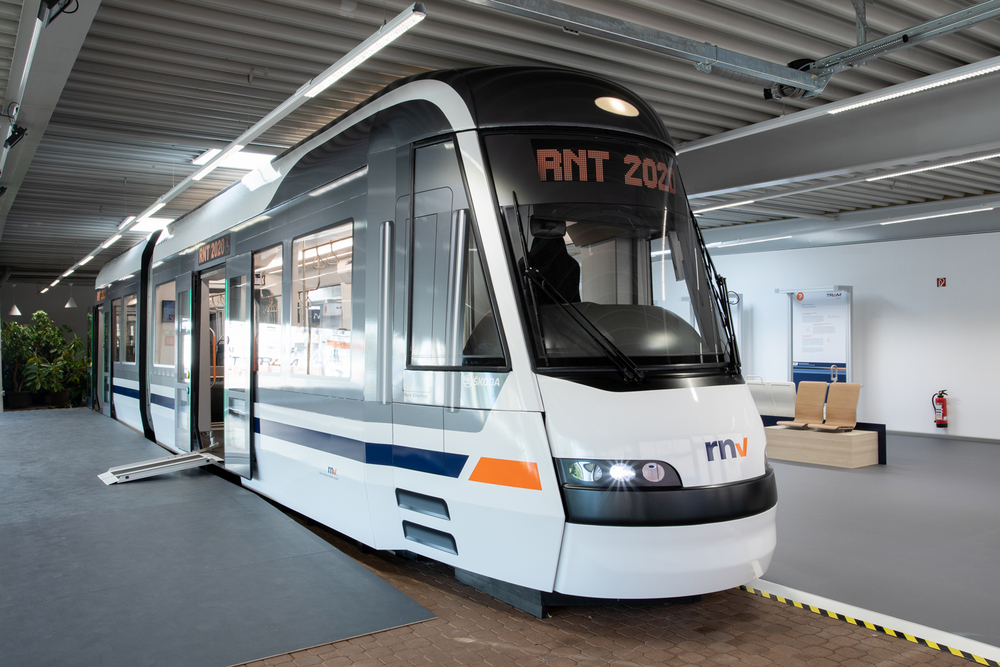
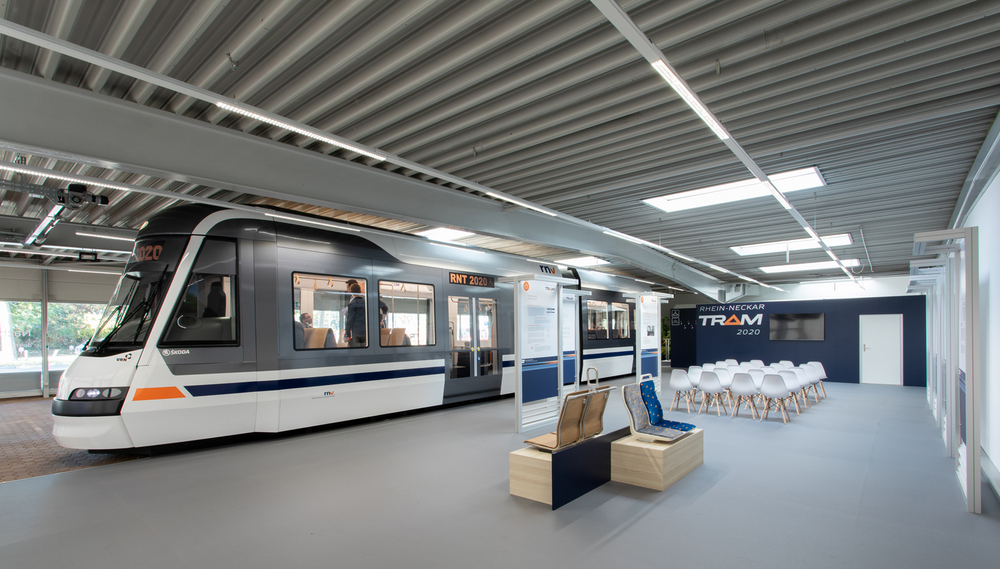
A true-to-scale 1:1 model - a so-called mock-up - was produced in order to be able to check the actual interaction between the functional solutions and the design concept. This was not only intended to serve as a visualisation for the representatives of the interest groups, but also for the public in order to provide a realistic basis for discussion and, if necessary, to define further development steps before the start of production.
Around two thirds of the mock-up's total mass is made of wood. A material mix of aluminium and fibreglass components, the installation of real windows and doors, as well as real seats and floor coverings, handrails and suggested passenger information systems in the interior realistically simulate the quality of life in the Rhein-Neckar-Tram. Many manual production steps such as mould making, woodwork, painting and assembly were used in the construction of the model, as well as high-tech processes such as CNC milling and 3D printing. The model measures around 16 × 2.40 × 3.50 metres and was delivered to Mannheim by special transport.
Dialogue Processes and Mobile Presentations
In autumn 2018, rnv launched a dialogue process with the help of the RNT mock-up. Passengers, associations and representatives from politics and administration were invited to take part in a tour of the 1:1 model and discuss the details of the new Rhein-Neckar-Tram that are important for passengers and operations in everyday life.
Interest groups from the entire region were invited, from the Passenger Advisory Council and railway and public transport customer associations to various institutions and committees representing the concerns and interests of people with disabilities, cyclists and senior citizens. The results of the joint site visits were systematically recorded and analysed.
The feedback and suggestions received in this way, for example on furnishings, comfort, suitability for everyday use and design, were comprehensively checked for technical, legal, economic and conceptual feasibility before production began.
Those results that were deemed feasible and did not represent a one-sided deterioration or disadvantage for individual user groups were ultimately incorporated into the final detailed plans and are reflected in the series vehicles. This enabled substantial improvements to be jointly developed and implemented.
In addition, rnv also invited all interested citizens to get involved in the aesthetic design of the interior of the new RNT and to vote on their favourite seat design. To this end, rnv was on site from mid-October 2018 with a mobile exhibition of the seat variants in the major shopping districts and pedestrian zones in the region from Ludwigshafen to Heidelberg, according to the motto: try out the seats, assess the colour alternatives and vote for your personal favourite version. Naturally, further information on the new trams was also provided at this presentation.