Rhein-Neckar-Tram
Attractive rail transport in the Rhine-Neckar metropolitan region should continue to grow and offer all passengers modern, reliable and ecological mobility. This is why Rhein-Neckar-Verkehr GmbH (rnv) is procuring new Rhein-Neckar-Tram (RNT) trams.
Get to know the Rhein-Neckar-Tram on the following pages and find out more about the vehicle of the future!

Low-floor light rail vehicles have been travelling through the Rhine-Neckar metropolitan region for almost 30 years: from the GTN light rail vehicles to the Variobahn trams, which mainly connect the cities of Mannheim and Heidelberg as well as the Bergstrasse region on Line 5. And the signs are pointing to growth.
The demand for efficient public transport is growing steadily. By 2030, rnv aims to double its passenger numbers. The rnv network has been modernised and expanded to provide attractive public transport. Further expansion routes into the surrounding area are planned. This brings with it new challenges.
At the same time, the old trams are getting on in years. They have to go into the workshop more and more often and are missing from the line. Repairs take longer or are more expensive due to a lack of spare parts. Passenger requirements have also changed: A light rail system should be low-floor and barrier-free and offer the option of boarding and alighting comfortably with aids. Added to this are travelling comfort, entertainment options and modern passenger information.
Largest single investment in the company's history
Against this background, it was the most efficient and economical solution for rnv to procure new trams that fulfil all these requirements. After an extensive Europe-wide tendering process, the company Škoda Transportation came out on top. For an order value of around 265 million euros, rnv has ordered 80 vehicles in three vehicle classes (30 metres, 40 metres and 60 metres). It is the largest single investment in the history of rnv to date.
An extensive dialogue process was carried out in order to design the new tram as customer-friendly as possible, especially with regard to people with restricted mobility and sensory impairments. This involved determining what makes an attractive light rail system and what is incorporated into the production and design of the new light rail system. The result is the Rhein-Neckar-Tram.
Longest metre-gauge tram in the world
On 18 October 2022, the time had finally come: the first 30-metre RNT with the number 1402 was delivered from Pilsen to the depot in Ludwigshafen-Rheingönheim by heavy goods transport. After training the driving and workshop staff as well as an extensive testing and approval process, the first vehicles went into passenger service for the first time on 19 April 2023 as special lines for the Bundesgartenschau in Mannheim and finally went into regular service in autumn 2023.
Since then, further Rhine-Neckar trams have gradually been delivered. The 40-metre RNTs are also in regular service. In September 2024, the currently longest metre-gauge tram in the world - the 60-metre-long RNT - arrived at rnv.





Documentation: The Journey of the RNT
The people behind the project talk about what it means to develop a new railway for the region, order it, have it built and finally put it on the track in a specially filmed documentary. In German language.
Answers to Frequently Asked Questions (FAQ)
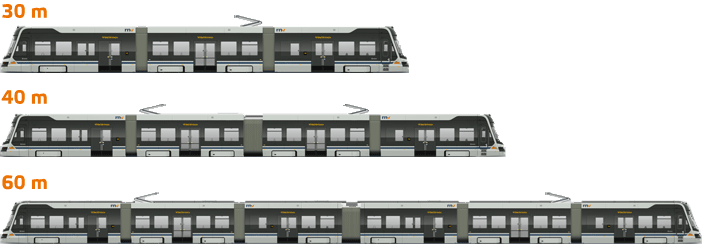
rnv's current order comprises 80 trams of the new Rhein-Neckar-Tram type. These will be procured in three different length classes: 31 30-metre vehicles, 37 40-metre vehicles and, for the first time, 12 60-metre trains. In addition, an option has been agreed with the manufacturer Škoda for the delivery of further trams.
The new vehicles will be delivered and put into operation continuously and will then be used throughout the entire rnv transport area. This means that all passengers on the rnv rail network from Bad Dürkheim via Ludwigshafen, Mannheim, Weinheim and Heidelberg to Bergstrasse will benefit from the advantages of the Rhein-Neckar-Tram.
The low-floor light rail vehicles that have been operating in the rnv transport area since the mid-1990s are getting on in years: They have to be repaired more frequently, spare parts are becoming scarce and, as a result, there will be a lack of vehicles on the route in the future. In addition, passengers' expectations of modern, barrier-free public transport have changed. Because more people in the region are to be transported on our trains in the future as part of air pollution control,CO2 savings and compliance with emission limits, routes have been modernised and further extensions are being considered.
The most efficient and economical solution for all these framework conditions was the procurement of new, modern light rail vehicles for the region.
A contract worth 265 million euros cannot simply be awarded. An EU-wide tender procedure must be carried out for this. Škoda Transportation submitted the most convincing offer in response to the tender carried out in 2017 and was awarded the contract.
The contract value of the firm order amounts to around 265 million euros for the 80 vehicles. It is the largest single investment in the history of rnv to date. For the financing, rnv is working together with the European Investment Bank (EIB) and a consortium consisting of KfW IPEX Bank and Nord LB. The cities of Mannheim, Ludwigshafen and Heidelberg have also provided corresponding guarantees. The state of Baden-Württemberg is supporting the procurement of the new Rhein-Neckar-Tram by granting a subsidy totalling a good 13 million euros.
The ticket prices of the Rhine-Neckar Transport Association (VRN) fare valid at rnv are set by the municipalities and transport companies represented in the association and are not directly related to rail procurement. Rather, the development of personnel and energy costs as well as the general price development are key factors influencing the level. There will therefore be no higher ticket prices directly related to the procurement of the new Rhine-Neckar Tram.