

Less Global Warming - Together We Can Reach Our Goal
It's getting warmer - even in the region: it's not just grandparents' memories of ice skating on the Rhine and Neckar in decades gone by or the monthly media reports about the warmest January, May or September since weather records began.
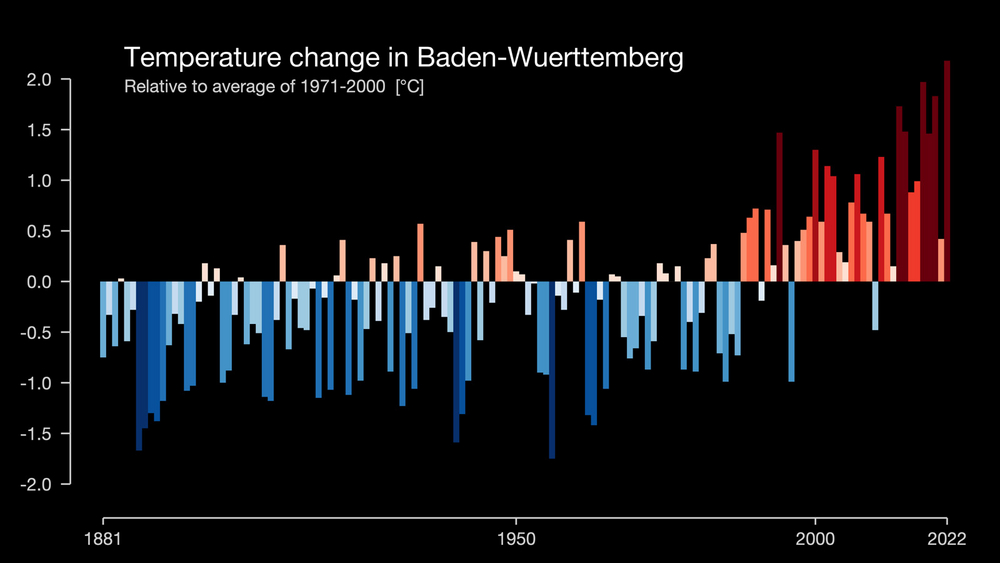
Warming Stripes Make Global Warming Visible
The "Warming Stripes" visualise global warming in a particularly impressive way. The stripes can be created using data for all regions of the world. Each stripe represents the average temperature for one year. White stripes indicate an average temperature, blue stripes a colder year, red stripes a warmer year.
It is noticeable that the past years have become continuously warmer, which is shown with (dark) red stripes. The diagram also shows how large the deviation from the average annual temperature is.
It's not just us in the Rhine-Neckar region who notice that it's getting warmer every summer. The effects of global warming affect the entire planet. Countries that lack the financial resources to prepare for climate change and where people are already struggling with extreme climate situations, such as prolonged drought, rising sea levels or increasingly extreme storms, are particularly affected. Severe weather such as the heavy rain and flooding in Valencia, Spain, Poland, the Czech Republic, Austria, Bavaria and Saxony in 2024 alone.
Switching to public transport - active climate protection
If you want to actively do something for climate protection, you can switch to local public transport when it comes to mobility. Because every kilometre that we travel by bus or train instead of by car saves CO2 emissions, the greenhouse gas that has a major impact on global warming. This means that our passengers make an active contribution to climate and environmental protection and less global warming with every journey they make. Get on board - together we will reach our destination.
Earth Hour and Public Transport - Active for Climate Protection
One campaign that promotes climate protection is Earth Hour. Since 2007, more and more people, companies and institutions have been switching off their lights or the exterior lighting of buildings and landmarks for one hour as part of this campaign. While Earth Hour was initially limited to the Sydney region in Australia, it became a global event just one year later, with 35 countries around the world taking part. In 2019, there were around 180 countries. In 2025, Earth Hour will take place on 22 March from 8.30 pm to 9.30 pm.
Anyone who not only wants to set an example for climate protection, but also actively do something for climate protection, can switch to local public transport when it comes to mobility. Because every kilometre that we travel by bus or train instead of by car saves CO2 emissions, the greenhouse gas that has a major impact on global warming. This means that our passengers make an active contribution to climate and environmental protection and less global warming with every journey they make. Get on board - together we will reach our destination.